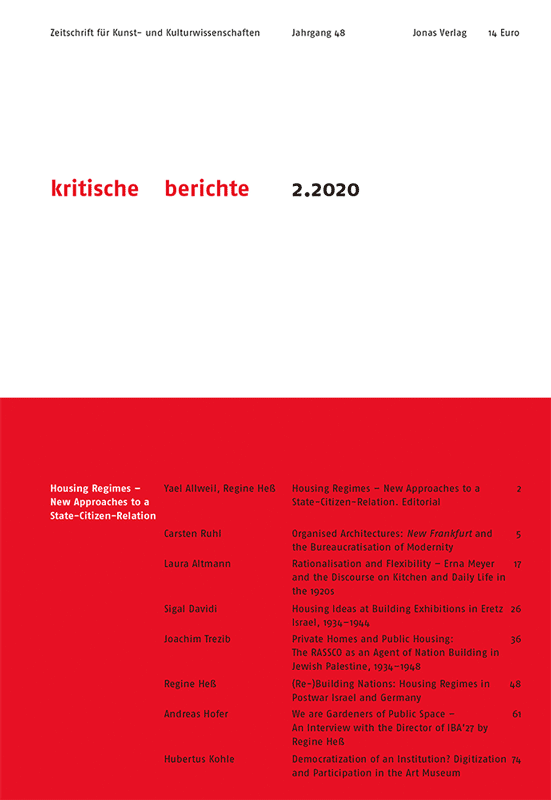
WOHNEN MIT KLASSE
ED. BY AMELIE OCHS AND ROSANNA UMBACH
SUPERVISION BY REGINE HESS
Kritische Berichte.
Journal for Art History
and Cultural Studies, 2/2025
Housing and class are inextricably linked. The articles in this issue analyze this connection with a view to images of housing in photography, film, magazines, architecture (debates) and on social media and discuss how class relations are made visible and invisible in them. The issue is published in German.
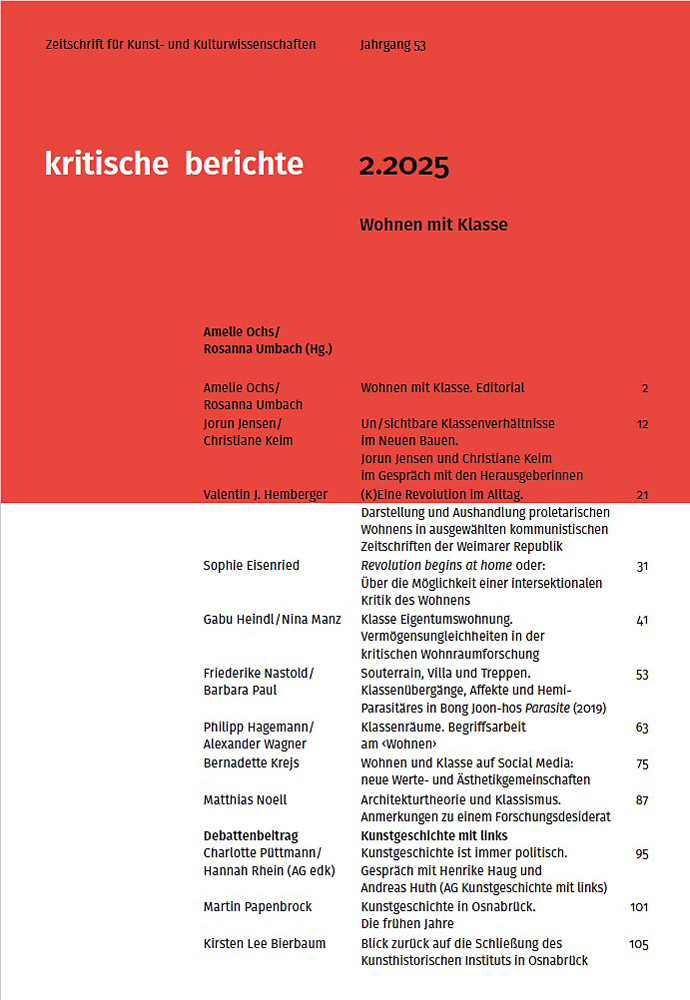
DAS ERBE VON
MINDERHEITEN /
THE HERITAGE OF
MINORITIES
ed. by Regine Hess,
ORKUN KASAP, SILKE LANGENBERG
Kritische Berichte.
Journal for Art History
and Cultural Studies, 1/2024
The issue brings together contributions from monument preservation, architecture and art history on topics of labor, gender, race, childhood, psychopathology, subculture and the right of marginalized groups to the European architectural and cultural heritage. The authors are Clara Arokiasamy OBE, President of ICOMOS UK (interviewed by Regine Hess), Tom Avermaete, Rune Frandsen, Kostas Tsiambaos, Coordinator of DOCOMOMO, Greece.
kb Debate 2024: The rules of the debate
The existential crises of recent years – climate change, the covid-19 pandemic, the latest wars and the rise of political populism – have led to a social debate culture that is increasingly emotional and ideological. The hardening of ideological standpoints and the communicative logic of the new media are accompanied by a boom in alternative offers of truth, which are increasingly accompanied by attacks on science and its institutions that constantly challenge the scientific rules of finding truth and solutions. The debate topic therefore aims to ask what strategies the humanities, and specifically art history, can offer to counter the erosion of the basic rules of a democratic exchange of opinions and the loss of trust in independent science. The debate begins with Wolfgang Ullrich’s contribution Kunstwelt im Konflikt.
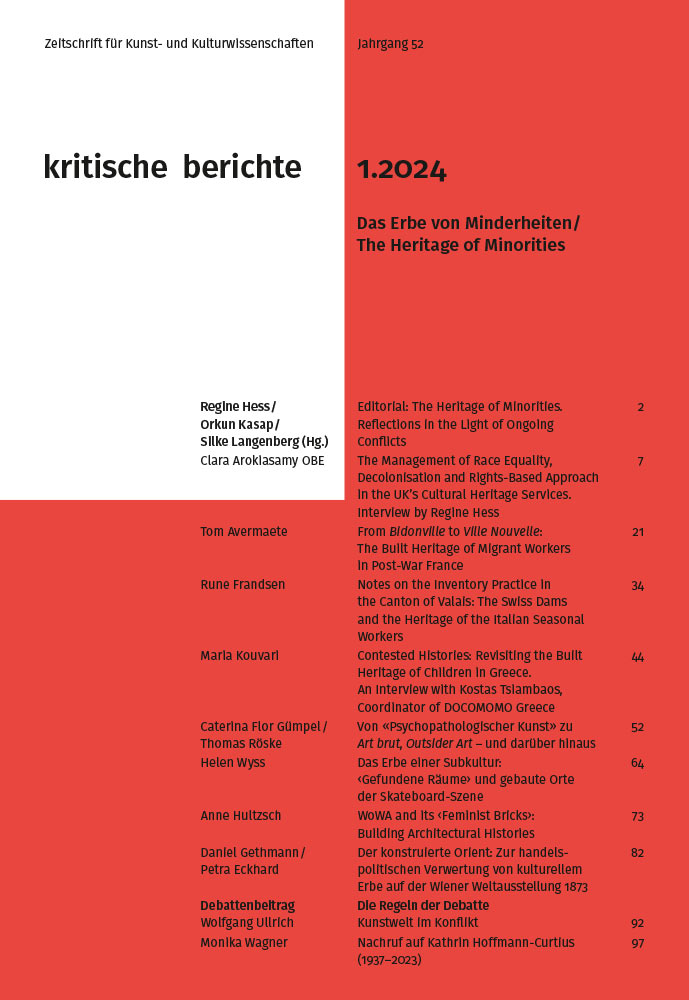
Architecture
Conflict
ed. by Regine Hess,
working group
Architecture Conflict
Kritische Berichte.
Journal for Art History
and Cultural Studies, 2/2023
This issue is dedicated to conflict in architecture. Here, we consider planning and building in at its most important – conflictual – stages, where a multitude of different actors are involved. Architecture and preservation are thus more strongly embedded in the political, social, and historical sciences. Researching controversies and the production of difference are guiding research principles. The working group Architecture Conflict is interested in a historical, source-critical perspective on built and unbuilt architecture, public space, infrastructures, as well as those narratives, institutions and interactions documenting that.
This year’s debate on Queerness in Art Sciences is continued by the contribution «Queer Spatial Practice: The Forum Queer Archive Munich as storage of memory and feeling».
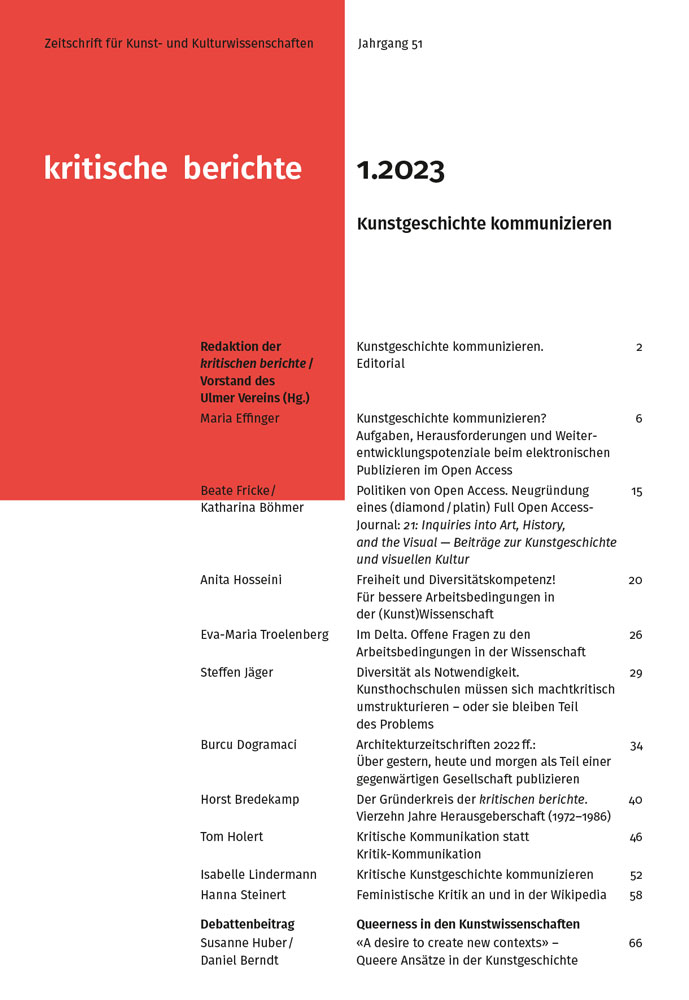
Kunstgeschichte
kommunizieren
ed. by Julian Blunk, Henrike Haug, Regine Heß, Andreas Huth, Henry Kaap, Franziska Lampe, Kathrin Rottmann, Yvonne Schweizer
Kritische Berichte.
Journal for Art History
and Cultural Studies, 1/2023
KritsChe Berichte
Debate
Undisciplined Institutions.
Questions of canon, visibilities,
actors
Many art and cultural institutions are currently undergoing a transformation process and are subjecting their collections, exhibition concepts and artifacts to a critical revision. This also concerns the reappraisal of their ideational and material genesis, which is determined by the perspective of the Global West. Linked to this is the task to build up a diverse personnel structure that leads to a greater variety of perspectives and positions.
The debate initiated by the board of the Ulmer Verein and the editors of the kritische berichte for the year 2022 would like to contribute to this necessary discussion about the rethinking of institutions.
PARTICIPANTS
CHRISTOPHER NIXON
Curator for colonial past and postcolonial present at Stiftung Historische Museen Hamburg
MARINA OTERO VEZIER
Head MA Social Design, Design Academy Eindhoven
MARÍA LÓPEZ-FANJUL
Curator for Outreach at Bode-Museum, Staatliche Museen zu Berlin
GABI DOLFF-BONEKÄMPER
Prof. em., TU Berlin
INA MERTENS
Library University of Bern
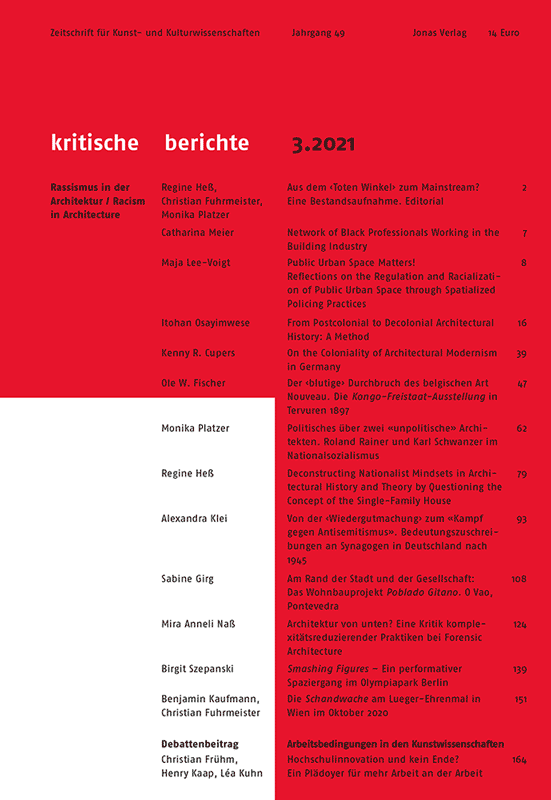
Racism in
Architecture
ed. by Regine Hess,
Christian Fuhrmeister
and Monika Platzer
Kritische Berichte.
Journal for Art History
and Cultural Studies, 3/2021
Racisms, ideologies, and power relations have become everyday topics of public debates also in the cultural sphere. Within these discursive processes, racism plays a key role: for European and non-European civil societies and actors, in research and teaching, in curatorial practices, in institutions and organizations, in discussing and writing, and in dealing with the past and the present.
Against this background, this issue gathers contributions that document critical thinking and expand our knowledge and thus (can) contribute to reflection. By renegotiating historical and current positions, constructs, practices, and narratives, we deliberately engage this debate in the field of architecture and public space: to what extent have racism and structural violence influenced architectural theory? In which areas of architecture and urbanism did and does racism leave its mark? How can architectural history be deconstructed anti-racistically?
By focusing on societies, we ask which forces can influence and shape creative work in architecture. At the same time, we need to address the part that our disciplines, professions, institutions, and organizations play in structural racism in science and society: How do our conscious and unconscious canons contribute to these tensions and injustices? Which mechanisms of inclusion and exclusion do we reflect, and which do we fail to reflect?
Read more about edition 3/2021 Ulmer Verein
Housing
Regimes
New Approaches to a State-Citizen-Relation, ed. by Yael Allweil and
Regine Hess
Kritische Berichte.
Journal for Art History
and Cultural Studies, 2/2020
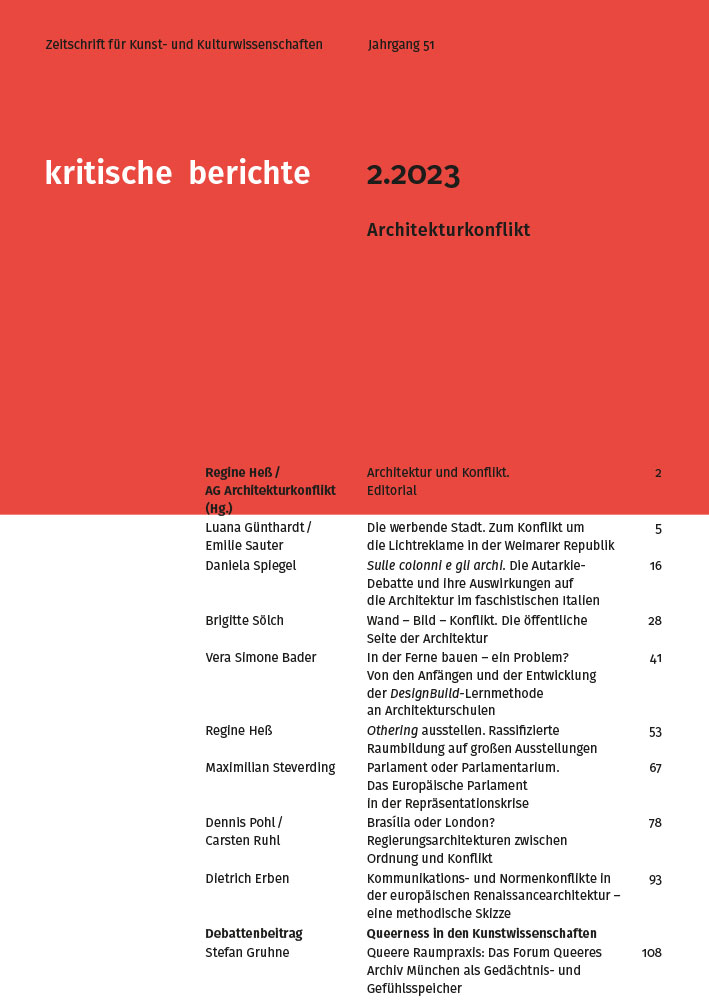
Housing, unlike wohnen, includes the sense of the German verb behausen, which brings the estate’s and the land’s provider into the picture. That is, the modern state (and its jurisdiction and building law), and its overarching goal of nation-building and establishing nationalism. Understood this way, housing has a double linguistic denotation and enables one to understand the production of ‹houses› and the subjection of its inhabitants to a regime or even competing re¬gimes, like that of East and West Germany during the Cold War.
Regime is defined by the Oxford dictionary as a «system of government or ad¬ministration» or as a term to «cover norm-bound interactions relating to issues such as the global environment or human rights». Understanding stately subsi¬dised housing this way, the history, sociology and anthropology of urban planning have devoted much research to planning mechanisms producing a «rule of experts» applying governing principles via urban and national infrastructure, while architecture studies on wohnen commonly focus on town planning and architectural housing design.
The here made shift in terminology has its impact on methodology. The articles in this volume reflects it with their new approaches to a broad realm of research fields.
Read more about edition 2/2020 Ulmer Verein